Morgan’s canon is a methodological principle widely used in psychology and across the sciences. Originally, it held that behavior should not be attributed to “higher” faculties if “lower” ones suffice. Despite its influence, the canon’s application remains debated. One common interpretation equates “lower” with “simpler” and frames the principle as an application of parsimony. However, critics argue this formulation makes it an unreliable epistemic guide. Alternatively, the canon may serve as a safeguard against anthropomorphic bias. This approach requires researchers to demonstrate that basic mechanisms cannot account for a behavior before they attribute more complex, human-like traits to an animal. Contemporary work on Morgan’s canon examines how we should interpret this principle and its role in scientific research.
History
Comparative psychology investigates the mechanisms, functions, and evolutionary histories of diverse cognitive capacities (Shettleworth, 2009) [see Animal Cognition]. British polymath Conwy Lloyd Morgan (1852–1936) sought to place the study of animal minds on a rigorous scientific footing. To achieve this, he introduced several methodological principles, including what became known as Morgan’s canon. This principle has had a profound impact on psychology as a whole, specifically on the study of animal minds. The canon is most famously articulated in Morgan's (1894) work, An Introduction to Comparative Psychology: “In no case may we interpret an action as the outcome of the exercise of a higher psychical faculty, if it can be interpreted as the outcome of the exercise of one which stands lower in the psychological scale” (p. 53; Figure 1).
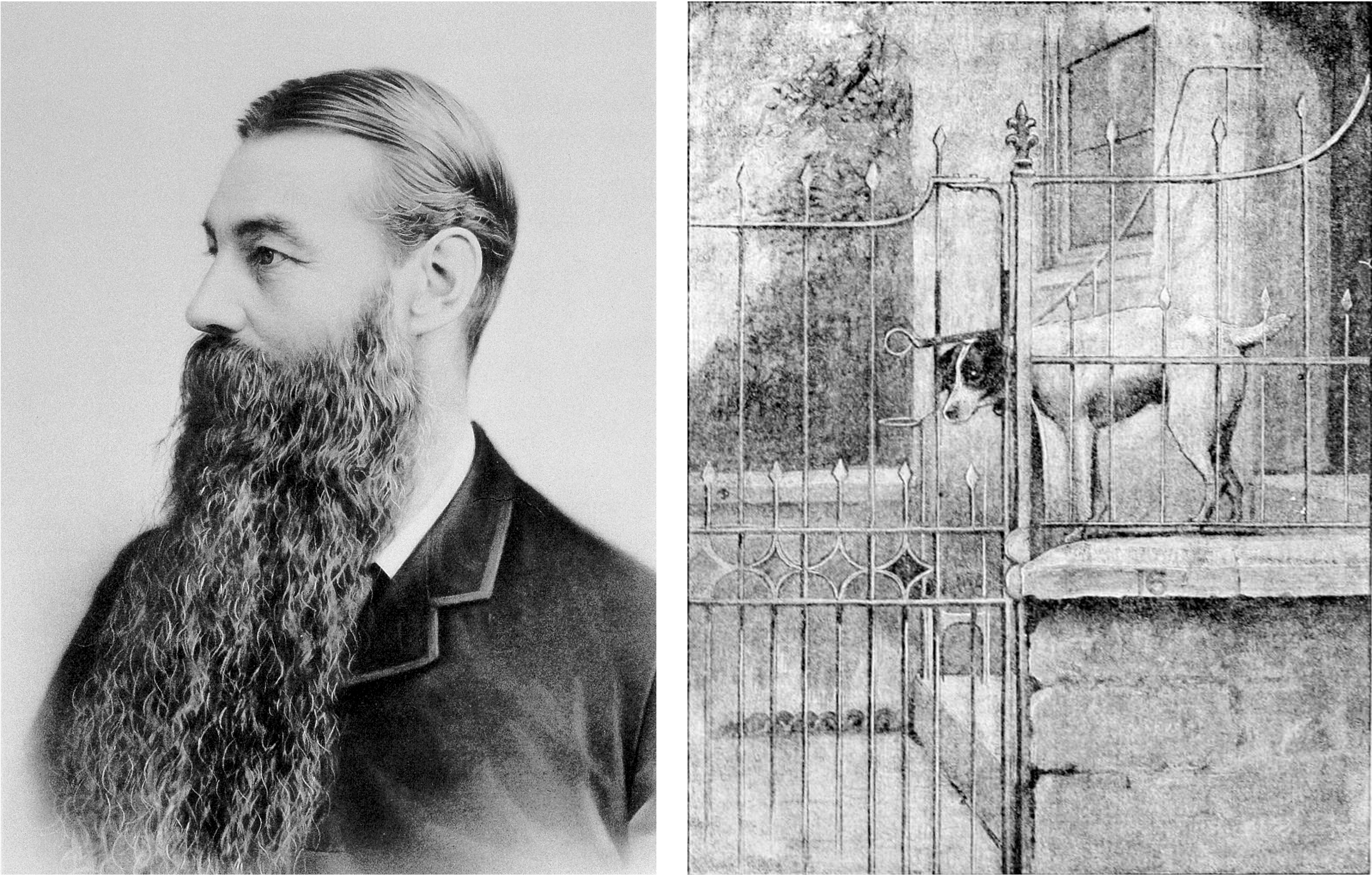
Pictured left: C. Lloyd Morgan (Wellcome Collection). Pictured right: Morgan’s illustration of his dog accidentally lifting a latch with his head—a “happy escape” that eventually resulted in a learned behavior for opening the gate (Morgan, 1920, p. 145).
By the early 20th century, Morgan’s canon was already linked to parsimony—the idea that, all else being equal, the simplest explanation is preferable (Newbury, 1954). This remains a dominant reading (see the section “Core concepts”), yet whether Morgan intended the canon to function this way is debated (Clatterbuck, 2016). Morgan famously warned that “the simplicity of an explanation is no necessary criterion of its truth” (Morgan, 1894, p. 54), noting that seemingly simple explanations often mistakenly appeal to familiar, human-like traits.
This observation supports a second interpretation of Morgan’s canon: that it is meant as a safeguard against anthropomorphism, or the attribution of human psychological traits to nonhuman animals (see Keeley, 2004). Some scholars argue that this reading conflicts with Morgan’s other commitments, however. Roger Thomas (1998), for instance, argues that this interpretation is in tension with Morgan’s reliance on introspection and analogy. Because Morgan believed researchers must first introspect their own mental states and then reason by analogy to understand the minds of other species, a human perspective remains inescapable. Applying this method means we are always engaging in some degree of anthropomorphism.
Alternative historical perspectives link the canon to Morgan’s shifting views on language and evolution. Gregory Radick (2000) argues the canon was initially influenced by philologist Max Müller’s claim that language is a prerequisite for reason. Under this view, because nonhuman animals lack language, their behavior cannot be interpreted through higher-level processes such as reasoning [see Uniquely Human Cognition]. Radick suggests that as research on animal communication challenged Müller’s stance, Morgan pivoted toward an evolutionary defense of the canon (see also Fitzpatrick & Goodrich, 2017). Specifically, Morgan held that evolution could vary animal minds without constraint, resulting in dramatic differences between species. The canon thus cautions against attributing human-like cognitive abilities to animals in the absence of strong, systematic evidence.
Core concepts
Today, the dominant interpretation of Morgan’s canon treats it as a parsimony principle (Voudouris et al., 2025) [see Ockham’s Razor]. However, this convergence belies a deeper disagreement regarding what constitutes simplicity in comparative psychology. For instance, the canon could be read as a requirement for ontological parsimony, favoring the hypothesis with the fewest cognitive processes, or as a requirement for evolutionary parsimony, favoring the fewest ancestral changes (Fitzpatrick, 2008). Alternatively, simplicity may be defined hierarchically, in which associative learning is prioritized over sophisticated abilities such as imagination or theory of mind (Shettleworth, 2009) [see Theory of Mind].
One key issue with the parsimony approach is that Morgan’s canon is presented as a general principle (applying across the board or trumping other epistemic values). However, depending on one’s notion of simplicity, the application of Morgan’s canon may lead to different outcomes. Requiring fewer evolutionary changes may dictate adopting the hypothesis with a greater number of cognitive processes, for instance (see Sober, 2005). For example, given the close phylogenetic relationship between humans and chimpanzees, we might accept the hypothesis that chimpanzees possess human-like causal learning abilities in addition to associative learning.
Morgan’s canon may lack justification as a universal parsimony principle, yet it may prove useful when applied in a context-specific way. Associative learning, for instance, is often described as a simple process because it is taxonomically widespread, appearing in nearly all vertebrates and several invertebrates such as honeybees and cuttlefish (Ginsburg & Jablonka, 2019). If a researcher knows that a particular species has these learning capacities, the canon may dictate ruling out such explanations before inferring more sophisticated traits, such as metacognition or causal learning [see Causal Learning; Metacognition]. In these instances, the canon serves as a targeted methodological tool rather than a general principle, applying only when “simple” capacities are empirically well motivated (see also Heyes, 2012).
Questions, controversies, and new developments
Many philosophers argue that Morgan’s canon is an impediment to research and should be mitigated or eliminated (Buckner, 2013; Fitzpatrick, 2008). These critiques rely on claims about the beliefs and practices of comparative psychologists, yet few systematic studies examine how modern practitioners understand and apply the canon. A recent qualitative study (Voudouris et al., 2025; Figure 2) reveals some divergences between practitioner views and claims found in the published literature. For instance, scientists do not appear to view the canon as making an associative–cognitive distinction. Further empirical research is needed to clarify how Morgan’s canon functions in daily scientific practice.
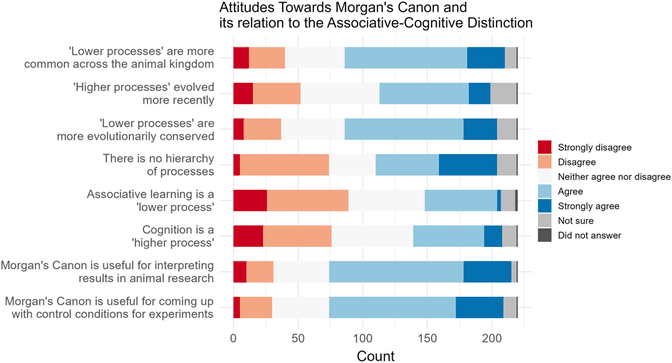
A selection of results from a survey of over 200 comparative psychologists (Voudouris et al., 2025, p. 249; CC-BY 4.0).
Broader connections
Morgan’s canon was advanced as an epistemic value designed to guide research. There is much discussion in the philosophy of science on the role of such values, such as why they are prioritized and how they interact with broader scientific and societal goals (Douglas, 2013; Sober, 2015). Any assessment of Morgan’s canon would benefit from being situated within this broader discussion.
Acknowledgments
This work was supported in part by a grant from the Templeton World Charity Foundation (TWCF-2020-20539).
Further reading
Clatterbuck, H., & Sober, E. (2025). Lloyd Morgan’s good argument for his canon. Belgrade Philosophical Annual, 38(2), 53–62. https://doi.org/10.5937/BPA2502053C
Fitzpatrick, S. (2008). Doing away with Morgan’s canon. Mind & Language, 23(2), 224–246. https://doi.org/10.1111/j.1468-0017.2007.00338.x
References
Buckner, C. (2013). Morgan’s canon, meet Hume’s dictum: Avoiding anthropofabulation in cross-species comparisons. Biology & Philosophy, 28, 853–871. https://doi.org/10.1007/s10539-013-9376-0
↩Clatterbuck, H. (2016). Darwin, Hume, Morgan, and the verae causae of psychology. Studies in History and Philosophy of Biological and Biomedical Sciences, 60, 1–14. https://doi.org/10.1016/j.shpsc.2016.09.002
↩Douglas, H. (2013). The value of cognitive values. Philosophy of Science, 80(5), 796–806. https://doi.org/10.1086/673716
↩Fitzpatrick, S. (2008). Doing away with Morgan’s canon. Mind & Language, 23(2), 224–246. https://doi.org/10.1111/j.1468-0017.2007.00338.x
↩Fitzpatrick, S., & Goodrich, G. (2017). Building a science of animal minds: Lloyd Morgan, experimentation, and Morgan’s canon. Journal of the History of Biology, 50(3), 525–569. https://doi.org/10.1007/s10739-016-9451-x
↩Ginsburg, S., & Jablonka, E. (2019). The evolution of the sensitive soul: Learning and the origins of consciousness. MIT Press.
↩Heyes, C. (2012). Simple minds: A qualified defence of associative learning. Philosophical Transactions of the Royal Society B: Biological Sciences, 367(1603), 2695–2703. https://doi.org/10.1098/rstb.2012.0217
↩Keeley, B. L. (2004). Anthropomorphism, primatomorphism, mammalomorphism: understanding cross-species comparisons. Biology & Philosophy, 19, 521–540. https://doi.org/10.1007/sBIPH-004-0540-4
↩Morgan, C. L. (1894). An introduction to comparative psychology. Walter Scott.
↩Newbury, E. (1954). Current interpretation and significance of Lloyd Morgan’s canon. Psychological Bulletin, 51(1), 70–74. https://doi.org/10.1037/h0059626
↩Radick, G. (2000). Morgan’s canon, Garner’s phonograph, and the evolutionary origins of language and reason. The British Journal for the History of Science, 33(1), 3–23. https://doi.org/10.1017/S0007087499003842
↩Shettleworth, S. J. (2009). Cognition, evolution, and behavior. Oxford University Press.
↩Sober, E. (2005). Comparative psychology meets evolutionary biology: Morgan’s canon and cladistic parsimony. In L. Daston & G. Mitman (Eds.), Thinking with animals: New perspectives on anthropomorphism (pp. 85–99). Columbia University Press.
↩Sober, E. (2015). Ockham’s razor’s: A user’s manual. Cambridge University Press.
↩Thomas, R. K. (1998). Lloyd Morgan’s canon. In G. Greenberg & M. M. Haraway (Eds.), Comparative psychology: A handbook (pp. 156–163). Garland.
↩Voudouris, K., Farrar, B. G., Cheke, L. G., & Halina, M. (2025). Morgan’s canon and the associative–cognitive distinction today: A survey of practitioners. Journal of Comparative Psychology, 139(4), 242–259. https://doi.org/10.1037/com0000404
↩